Quick Answer
Before sending money to any investment, ask where the return actually comes from, verify the firm on your own country's financial regulator register — typed in yourself, never from a link you were sent — and find out by name who holds your money and what happens to it if the firm disappears. If you can't get a plain answer to any of those, wait. Genuine opportunities survive a few days of checking, and anyone who won't let you check is telling you something important.
The first payment is almost never the problem.
A man in his fifties, an engineer, sensible with money his whole life, put in £500. He got it back nine days later with £68 on top. He took a screenshot. He showed his wife. She was sceptical, so he withdrew again, a slightly larger amount, and that came back too. Over the following four months he moved £61,000 across in fourteen transfers, including the tax-free portion of his pension.
The withdrawal button stopped working in October. Support told him there was a compliance hold and he needed to pay a 12% "release fee" to clear it. He paid it. Then there was a second fee. By the time he stopped paying, he had lost the fee money as well.
That story is a composite. I have put it together from the shape that these cases take again and again, because the details vary and the structure almost never does. The structure is what this article is about.
Here is the part that should worry you. Nothing in that sequence looked like a scam while it was happening. There was a real app with a real chart that updated in real time. There was a support agent who replied within four minutes at eleven at night. There was a WhatsApp group of 340 people posting their own screenshots, and some of those people were real, and some of them had genuinely been paid. There was a certificate of incorporation, publicly verifiable, with a company number that checked out.
All of that is cheap now. A convincing trading platform costs less to build than a secondhand car.
The numbers, briefly, and then I will stop with the numbers
The FBI's Internet Crime Complaint Center took just over a million complaints in 2025 and recorded total reported losses of $20.9 billion. Investment fraud was the single largest category at more than $8.6 billion, roughly triple the next category down. Complaints involving cryptocurrency accounted for $11.4 billion of that total, and where crypto was involved the average reported loss jumped from about $20,700 to about $62,600.
In the UK, City of London Police recorded £879.8 million lost to investment fraud in 2025 from 34,673 reports, up 31% on the year before. Average loss per person: £25,612. That is not fun money. That is somebody's deposit, or the pension pot they spent thirty years building.
One statistic matters more than all the others. The FBI runs a programme called Operation Level Up, where investigators identify people who are currently being defrauded and contact them to warn them. In 2025 they notified 3,780 people that the platform they were using was fraudulent. Seventy-eight per cent of them had no idea.
78%
of the people the FBI's Operation Level Up team contacted mid-scam in 2025 had no idea the platform they were using was fraudulent
FBI, 2025
Think about what that means. Not "78% were suspicious but hoped for the best". Seventy-eight per cent were mid-scam, watching their balance go up, and believed everything was fine until a federal agent phoned them.
That is the honest starting point for this article. You cannot rely on the scam feeling like a scam. It will not. You need a method instead.
What this article is and is not
This is not an argument that everything is a scam. Most people who lose money to investment fraud were not being reckless. They were being trusting, which is a different thing, and usually they were being trusting in the direction of a person they knew.
This is also not a hit piece on any particular platform. Naming names has a short shelf life. The platform taking money this month will have a different name by Christmas, the same backend, and a new set of testimonials. What lasts is the method for checking, so that is what I am giving you.
By the end you should be able to look at any opportunity that comes across your phone and know what to ask, in what order, and what an unsatisfying answer looks like.
One last thing before we start. Being clever does not protect you. Doctors get taken. Accountants get taken. There is a documented case pattern where the victims skew educated and financially literate, because financially literate people are the ones with money to move and the confidence to move it. What protects you is a checklist you follow even when you feel silly following it.
The reverse is also true, and it matters more. Not knowing much about finance does not make you the intended victim of a lesser scam. It makes you the intended victim of the same one, arriving with an explanation you have no way to test. These schemes are built to work on both ends of the knowledge range at once, and they are increasingly run from one country into another, which is a pattern I come back to in Part Six because it changes what your options are afterwards.
Part One: What you are actually buying when you invest
Most people who lose money to fake investments have never had anyone explain to them how the real thing produces money. That gap is the whole business model. If you do not know where a legitimate return comes from, you cannot notice when a promised return comes from nowhere.
So, plainly.
A share is a piece of a company. If a company has issued a million shares and you own a thousand of them, you own a thousandth of that business. You own a thousandth of its factories, its brand, its contracts and its problems.
Your return comes from the business doing well. There are two ways this reaches you. The company can pay out part of its profit to shareholders, which is a dividend. Or the business can become more valuable, so other people will pay more for a share than you did, which is capital appreciation. That is it. Those are the mechanisms.
A stock exchange is a marketplace. The London Stock Exchange, the New York Stock Exchange, Nasdaq, the Nairobi Securities Exchange, the Johannesburg Stock Exchange. An exchange does not sell you anything. It matches people who want to buy with people who want to sell, and publishes what price they agreed at. It is closer to a fish market than a shop.
A broker is the firm that gets you into that marketplace. You cannot walk onto an exchange floor. You open an account with a broker, you tell them what you want, and they execute it. Interactive Brokers, Charles Schwab, Fidelity, Hargreaves Lansdown, Robinhood, eToro. Different fee models, different features, same fundamental job.
An investment adviser tells you what to buy. A portfolio manager makes those decisions on your behalf, inside a mandate you have agreed. An analyst researches companies and publishes opinions. These are separate jobs with separate qualifications and separate licences, and a firm that claims to be doing all of them at once, while also holding your cash, deserves more questions rather than fewer.
Bonds work differently but no more mysteriously. You lend money to a government or a company for a fixed period, they pay you interest, and at the end you get your capital back if they are still solvent. Property pays you rent. A small business pays you a share of its profits. In every case there is an underlying economic activity, and you can point at it and describe it in a sentence.
Here is the sentence that runs through this entire article, and I would like you to hold onto it:
The money has to come from somewhere. If nobody can tell you where, in ordinary language, you have not found an investment. You have found a story.
What real returns look like when nobody is selling you anything
Long-run average returns on a broad basket of global shares land somewhere around 7% to 10% a year before inflation, and that average is made of violently uneven years. 2008 took roughly a third off global equity markets. 2020 fell about 30% in five weeks and then recovered. Anyone who tells you they can produce steady monthly gains from markets that behave like this is telling you something about markets that is not true.
A promise of 3% a week compounds to more than 360% a year. If someone could reliably do that, they would not need your £500. They would be running the largest fund in human history within four years, and there would be a paper about it.
Part Two: What trading is, and why nobody wins every trade
Trading is buying something with the intention of selling it fairly soon, and profiting from the price difference. Same instruments, shorter horizon, much higher failure rate.
Prices move because of supply and demand, which sounds like a truism until you sit with it. A price is just the last number at which a buyer and a seller agreed. When more money wants in than wants out, the number goes up. When it flips, it goes down. Everything else, all the news, all the earnings reports, all the interest rate decisions, works by changing how much money wants in.
Traders use two broad approaches to guess what happens next. Fundamental analysis looks at the business or the economy: revenue, debt, margins, inflation, policy. Technical analysis looks at price history and volume, on the theory that patterns of behaviour repeat. Both are used seriously by serious people. Neither is a formula. If either one worked reliably, its edge would disappear the moment enough people copied it, which is exactly what keeps happening.
Now the part that gets left out of every WhatsApp pitch.
Professional traders lose. Constantly. A good discretionary trader might be right on 45% of positions and still make money, because they cut the losers fast and let the winners run. Losing weeks are routine. Losing months are normal. Losing years happen to people with two decades of experience and a Bloomberg terminal.
Multiple regulators in Europe require brokers offering leveraged products to publish the share of retail accounts that lose money. Those disclosures have hovered somewhere in the region of 70% to 80% for years. That is at real, licensed, regulated firms, where the trades are genuinely being placed.
So when an account shows you 30 wins and no losses, you are not looking at a talented trader. You are looking at a spreadsheet.
The single most useful thing to know about legitimate trading is that it is uncomfortable. It involves drawdowns you have to sit through and days you close your laptop feeling stupid. Fraud removes the discomfort, because discomfort makes people withdraw, and the entire operation depends on you not withdrawing.
Part Three: Who actually holds your money
This is the boring plumbing question and it is worth more than any other question in this article.
At a properly regulated broker, your money and your assets do not belong to the broker. Client funds sit in segregated accounts at a bank, separate from the firm's own money. Your shares are held by a custodian, often in a nominee arrangement, and the records show they are yours. If the broker goes bankrupt tomorrow, administrators are supposed to be able to identify your assets and return them or move them to another firm, because they were never the failed company's property to spend.
There is usually a compensation scheme sitting behind that as a second layer. The UK's Financial Services Compensation Scheme covers eligible claims up to £85,000 per person per firm. In the United States, SIPC covers up to $500,000 in securities. These schemes cover the firm failing or misappropriating assets. They do not cover your investment falling in value, and they emphatically do not cover an unregulated offshore platform that took your crypto.
Against that, picture the typical fraudulent platform. You send money to a wallet address or to a personal bank account or to a company account in a jurisdiction you have never thought about. There is no custodian. There is no segregation. There is no compensation scheme. The number on your dashboard is not a claim on anything. It is text in a database that somebody else controls, and they can change it, and one day they will.
So the question, asked plainly:
"Who is holding my money, what is their name, and how would I get it back if you disappeared?"
An honest firm has a dull, immediate answer with names in it. Watch what happens when the answer is a feeling instead.
Part Four: How the trust gets built
Nobody hands £30,000 to a stranger. They hand it to someone who has become, over several weeks, not a stranger. Understanding that construction process is most of the defence.
It usually starts with someone you already trust. A cousin. A colleague. Someone from church. Someone in a group chat you have been in for two years. This is the most important design feature of the whole thing and it is not accidental. Introductions through existing relationships bypass the scepticism you would apply to a cold call, and the person introducing you is very often a genuine victim who thinks they are doing you a favour. They have withdrawn successfully. They are not lying to you. They are wrong, and they do not know it yet, and their sincerity is doing the work.
Then comes the environment. A group with hundreds of members. Daily signals posted at fixed times. Members posting profit screenshots, congratulating each other, asking beginner questions that get answered patiently. Some of those members are staff. Some are bots. Some are real people who joined last month. You cannot tell which from the inside, and the mixture is deliberate, because a group of pure bots reads wrong and a group of pure victims does not push hard enough.
Then authority. A professor, a mentor, an analyst, a fund manager who has decided to teach for reasons that are never quite examined. He posts market commentary that sounds right, because market commentary that sounds right is not difficult to write and can be lifted from anywhere. Titles do heavy lifting here. We are trained from childhood to give ground to expertise, and almost nobody checks whether the expertise exists.
Then proof. Withdrawal videos. Screenshots. A short clip of somebody's banking app. Occasionally an office with a glass frontage and a printed logo. Increasingly, a video of a famous investor endorsing the platform, which is generated, and which is now good enough that you cannot reliably catch it by looking. The FBI logged more than 22,000 complaints in 2025 involving AI-generated elements, with losses near $893 million, and investment fraud was the largest slice of that.
Then a small win. You put in a modest amount. It grows. You withdraw it. It arrives. This is the hinge of the entire operation and I have given it its own section later, because it deserves one.
Then urgency. A window closing. A round filling. A rate dropping on Friday. Urgency is not a sales technique here, it is a defence mechanism: it exists specifically to stop you doing the thing this article is teaching you to do, which is go away, check, and come back in a week.
Notice that not one item on that list is evidence about where the returns come from. Every single one is evidence about how the operation presents itself. Those are different categories of fact and the confusion between them is where the money goes.
Part Five: Why this works on anyone
I want to handle this carefully, because most writing on scam psychology has a faint tone of "here is why the victims were foolish", and that tone is both wrong and actively harmful. It is wrong because the mechanisms below are not defects. They are the ordinary operating system of a functional social human. And it is harmful because shame is the reason people keep paying release fees instead of telling their family.
Social proof. In genuinely uncertain situations, copying the crowd is a rational shortcut. It is how you pick a restaurant in an unfamiliar city. Fraudulent operations do not defeat this instinct, they feed it, by manufacturing a crowd. The instinct then functions exactly as designed, on fabricated inputs.
Authority bias. Deference to credentials saves you enormous amounts of time in a complex world. You do not personally verify your surgeon's training. The exploit is trivially simple: claim the credential.
Reciprocity. Someone gives you free signals for three weeks, answers your questions at midnight, sends you a voice note when your mother is ill. You now owe them something, and the debt is felt long before it is examined. Free value up front is one of the oldest structures in confidence work because it converts a transaction into a relationship.
Commitment and consistency. Once you have said out loud that you are an investor, once you have told your sister about it, backing out means admitting you were wrong in public. Small initial commitments are not designed to make money. They are designed to change your self-description.
Sunk cost. After £40,000, walking away means the £40,000 is definitely gone. Continuing means it might not be. Every additional payment feels like protecting the previous ones. This is why the fee stage works, and why it works repeatedly on people who can explain the sunk cost fallacy in a job interview.
Hope, which is not the same as greed. The greed framing is the one everybody reaches for and it is only sometimes right. A large share of victims are not chasing a yacht. They are trying to fix something: a shortfall in retirement, a child's school fees, a business that did not survive. Someone in a repair mindset evaluates opportunities differently from someone in an acquisition mindset, and fraudulent pitches are increasingly written for the former. Ask why so many of these operations target people over sixty, who accounted for $7.7 billion of US reported losses in 2025.
In-group loyalty. If it came through your church, your diaspora network, your professional association, then doubting the investment feels like doubting the community. This has a name in the literature. Affinity fraud is one of the oldest and most reliable structures there is, precisely because the social cost of asking a hard question is highest exactly where the question is most needed.
The uncomfortable summary: the people who lose money are usually not the least careful people in the group. They are often the most connected.
Part Six: Who these schemes are actually built for
There is a myth that fraud finds the gullible. It does not. It finds two groups at once, and they are almost opposites.
The first group has money and confidence. Professionals, business owners, people who have handled a mortgage and a pension and consider themselves financially competent. They are targeted because they have capital to move and the authority to move it without asking anyone. Their competence is the vulnerability: someone who understands compound interest is more susceptible to a well-constructed compounding story, not less, because they can follow the maths and the maths is internally consistent. It is only the inputs that are invented.
The second group has never been taught how any of this works. Nobody explained what a share is, what a broker does, why a return has to have a source. For them there is no baseline to compare against, so a claim of 8% a year and a claim of 8% a week land in the same place. Both are just numbers a confident person said. When you have no model of how money is legitimately made in markets, you cannot detect an impossible one, and the absence of that model is not stupidity. It is a gap in what schools taught.
Between those two groups sits the demographic that loses most often and recovers least: the salaried middle, working hard, slightly behind, aware that a salary alone is not going to get them where they need to be.
The geography of it
The operators and the victims are usually not in the same country, and often not on the same continent.
Modern schemes are frequently run from one place and marketed into another, using foreign association as the credential. CBEX, which collapsed across Nigeria and Kenya in April 2025, branded itself in a way that implied a link to a Chinese state-connected exchange. The Beijing Equity Exchange publicly denied any affiliation. CBEX displayed a US FinCEN registration as evidence of legitimacy, which, as covered later, is a filing rather than an approval and authorises nothing resembling investment services. There were no real branches outside Nigeria. Business Insider Africa estimated that between 250,000 and 300,000 Nigerians put money in.
That structure repeats: a name that sounds American, British, Chinese or Emirati, a registration document from a jurisdiction the target audience cannot easily check, and a marketing operation on the ground in Lagos, Nairobi, Accra or Johannesburg run by locals who are often themselves participants rather than employees.
The reason this works is not that people in those markets are less careful. It is that the verification infrastructure is thinner and the consequences are heavier. If a UK investor loses £20,000 to a firm operating without permission, there is an FCA warning list, a fraud reporting service, a bank with a reimbursement obligation in some payment scenarios, and, if the firm was authorised, a compensation scheme up to £85,000. If a Kenyan teacher loses the same amount, there is a regulator issuing an alert after the fact, a criminal investigation that will take years, and, realistically, no recovery.
The scale is not small. Ghana's central bank found that 119,300 people lost about GH¢59.6 million to just four schemes in 2018, and that figure excluded the largest case of the period. Nigeria's SEC has put cumulative losses to Ponzi schemes and unlicensed fund managers at more than $218 million. South Africa has produced cases in the billions of rand, including one where the operator was convicted on 207 counts of fraud.
The teacher problem
Teachers show up in these cases repeatedly, and so do nurses, police officers, junior civil servants and church administrators. There is a structural reason, and it is worth spelling out because it is not about naivety.
Salaried public sector workers have two things fraudsters need. They have predictable income, which makes them creditworthy. And they have access to credit that is cheap and fast, through employer schemes, cooperatives, savings and credit societies, or unsecured salary-backed loans.
That combination creates the most destructive sequence in this entire subject.
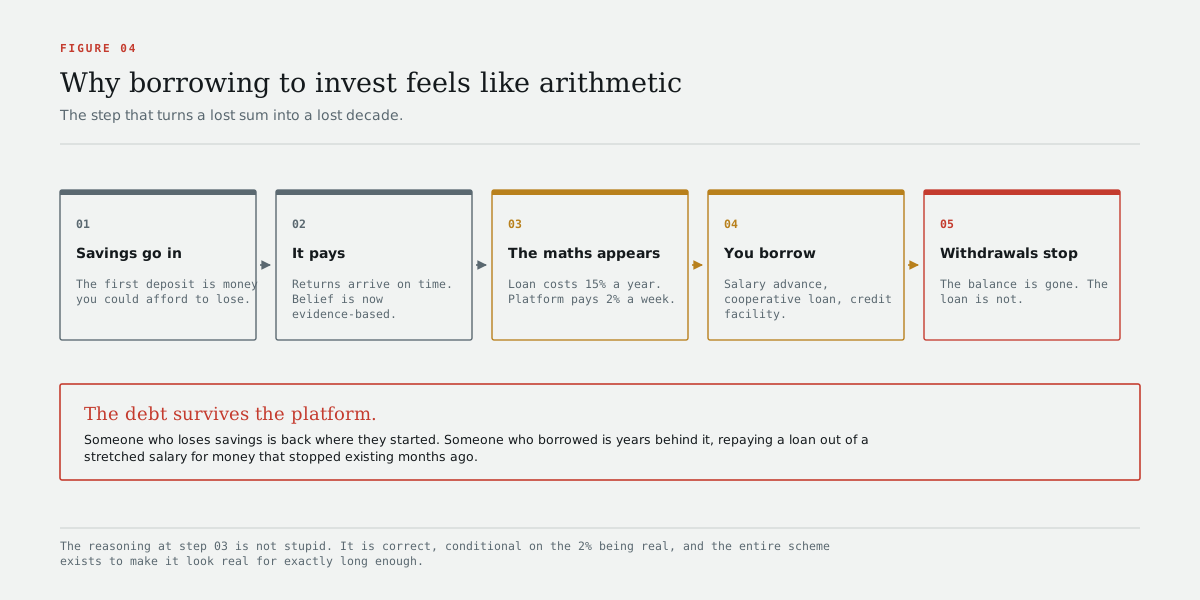
It goes like this. You invest savings. It pays. You invest more savings. It pays. You now believe you have found something reliable, and you notice that the platform pays more per month than your loan costs per month. So borrowing to invest stops looking reckless and starts looking like arithmetic. If the loan costs 15% a year and the platform pays 2% a week, only a fool would not borrow. That reasoning is not stupid. It is completely correct, conditional on the 2% being real, and the entire scheme exists to make the 2% look real for exactly long enough.
One Kenyan government worker interviewed after the CBEX collapse said he lost around 2.1 million shillings, roughly $16,000, most of it borrowed from a bank he still has to repay. He asked not to be fully named because of the shame.
That is the outcome that makes this different from an ordinary bad investment. Someone who loses savings is back where they started. Someone who borrowed to invest is now years behind where they started, servicing a debt for money that no longer exists, with the repayments coming out of a salary that was already stretched. The scheme did not just take the upside. It took the future.
If you take nothing else from this section
Never borrow to invest in anything that promises a fixed return. The fixed return is the bait precisely because it makes the borrowing maths work.
The person who brought you in
There is a second casualty in every one of these cases and it gets almost no attention.
Another Kenyan participant told reporters after the CBEX collapse that he had introduced 25 family members and friends. They lost everything. He said he would like to help them recover but he is broke himself.
Think about what that man is carrying. He was not a fraudster. He was persuaded, then rewarded for persuading, then believed sincerely enough to bring in his own mother's friends and his cousins. The referral commission that made him an evangelist also made him, in the eyes of everyone he recruited, the person responsible.
This is the quiet damage that outlives the money. Families stop speaking. Church groups fracture. The person who brought everyone in stops attending, because they cannot face the room. When people say these schemes leave communities worse off, this is a large part of what they mean, and it does not appear in any loss statistic.
Part Seven: "I know it's a scam, but I'm making money"
This is now the most common response you will get. Not denial. Something more sophisticated and much harder to argue with.
I know it's a scam. I'm not stupid. I'll take my profits and get out before it collapses.
I want to take this seriously, because the person saying it is not being irrational in the way the earlier victims were. They have correctly identified the structure. They have simply reached a different conclusion about what to do with that knowledge, and their conclusion is wrong for reasons that are worth setting out properly rather than dismissing.
Here is why the plan does not work.
You do not know where you are on the curve, and the operator does. They can see total deposits, total withdrawals, the rate of new joiners, and the exact day the two lines cross. You can see your own dashboard. The information asymmetry is total, and the decision about when to close is made by the person with all the information, against the interests of the person with none.
The collapse is timed to be maximally profitable, not random. Schemes tend to end shortly after a marketing push, a new tier launch, a bonus event, or whatever produced the largest recent inflow. That means the moment of maximum confidence in the group chat is also the moment of maximum danger. The signals you are watching for as your exit cue are manufactured by the person you are trying to outrun.
Your exit requires the withdrawal function to work, and the withdrawal function is the switch. The plan is not "watch for warning signs and leave". The plan is "successfully complete a large withdrawal at the exact moment the operator is deciding whether to allow large withdrawals". CBEX did not announce a wind-down. It blamed a security breach, promised a system upgrade for the 15th, and instead zeroed the balances. Then it asked for a verification fee of $100 to $200 for the chance of getting anything back.
Almost nobody actually takes the profit out. This is the one I would emphasise. The whole appeal is compounding, so leaving the money in to compound is not a lapse of discipline, it is the strategy. People who intend to withdraw at month six find that at month six the returns are excellent and withdrawing feels like leaving money on the table. Nigerian reporting on CBEX described exactly this: early returns encouraged people to reinvest rather than withdraw, which fed the structure that then collapsed on them.
Even if you get out, the money you took came from a person. Not from a market, not from a bot, not from the operator's pocket. It came from a deposit made by someone later than you, and there is a reasonable chance you know their name, because these schemes travel along relationships. You are not beating the house here. There is no house. There is a queue, and getting your money out means someone behind you does not.
And you may not get to keep it anyway. In many jurisdictions, when a fraudulent scheme is wound up, liquidators can pursue people who withdrew more than they put in and recover those profits for the general pool of victims. This is not theoretical. In one South African collapse, liquidators asked the court to order 871 investors to return payouts they had received. Net winners can end up as defendants. Some victims in that case did not even report their losses, out of fear of being asked to repay earlier gains.
So the honest version of your friend's plan is: I am going to try to take money from people I know, on the basis of information I do not have, using an exit that the fraudster controls, in a scheme I have already correctly identified as fraudulent, and I may be sued for it later.
Put like that it is a worse trade than it sounded.
On the acceptance
The part of this I find genuinely bleak is how normal it has become. In a lot of places these schemes are no longer even controversial. Everyone knows. The joke gets made in the group chat while people are still depositing. The name changes every couple of years, MMM in 2016, something else in 2020, CBEX in 2025, and the acceptance is a kind of exhausted realism: the economy is hard, wages have not moved, the formal options are slow and boring and require capital nobody has, and here is a thing that might work for a bit.
I do not think you argue people out of that with lectures about risk. The counter-argument has to be the one thing the scheme cannot survive, which is the actual arithmetic of what happens to the group as a whole. Every scheme of this type is net negative. Not on average. In total. The sum of everything paid out is smaller than the sum of everything paid in, because the operator keeps the difference and then keeps the remainder as well. So while any individual can win, the participants collectively cannot, and there is no strategy available to the group that changes it. Somebody is always holding it when it stops, and by design it is most people, because the scheme is largest on the day it dies.
That is the version worth saying to a friend. Not "you will lose", because they might not. But: for you to win, several people you know have to lose, and the odds of you being the one who wins are set by someone who is lying to you.
And after CBEX collapsed and the arrests began, reporters accessing its private Telegram groups found it had restarted operations. That is what this industry does. Nobody is out-timing a machine that can simply begin again.
Part Eight: The one question that does most of the work
If you take a single thing from this article, take this one.
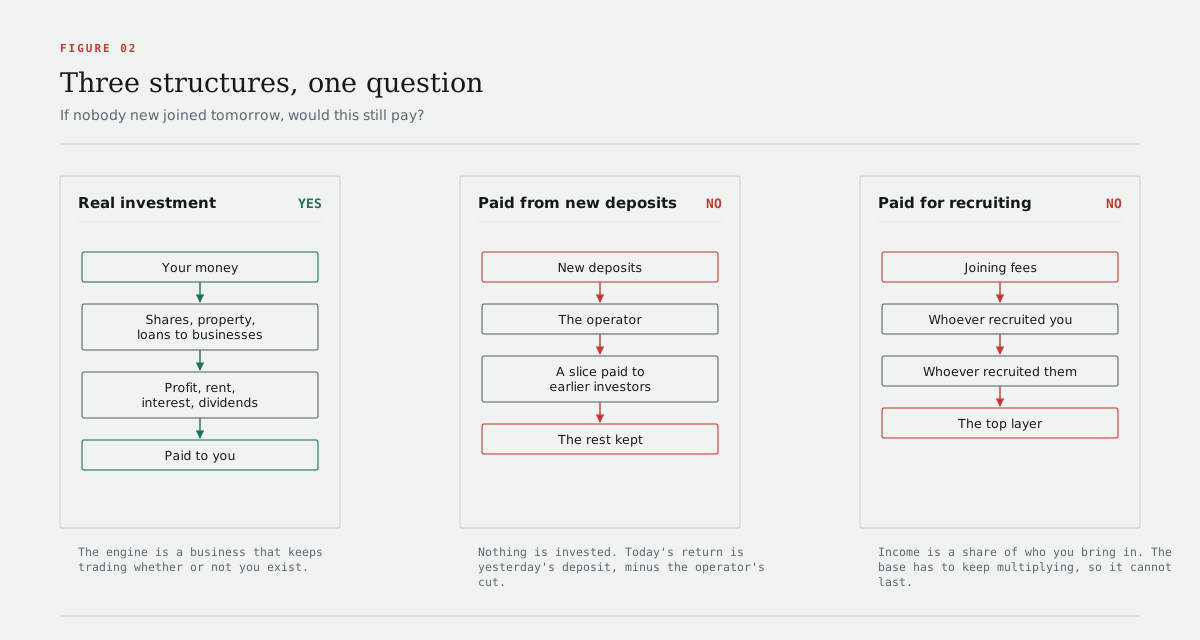
If nobody new joined tomorrow, would this business still make money?
Sit with it. It cuts through nearly everything.
A supermarket passes. It sells food at a margin. If it stopped recruiting new customers entirely and served only its existing ones, it would make less money, but it would make money, because the money comes from selling food.
A fund that owns shares in 500 companies passes. Those companies keep producing and selling things. New investors are irrelevant to whether Unilever sells soap.
A landlord passes. Tenants pay rent.
Now apply it to a platform where your daily return is described as coming from "AI arbitrage across exchanges" and where the fastest way to increase your income is to bring in three friends. If nobody new joins tomorrow, what pays your 2% today? If the honest answer is "the deposits of the people who joined yesterday", you are looking at a structure where existing participants are paid from new participants' money, which must fail eventually, and whose only open question is when.
Ask the question out loud in the group. Watch the response. That response is data.
The full list
Print this. Put it in your notes app. Work through it before any money moves, and be suspicious of your own reluctance to be rude.
Where the money comes from
- In one sentence, using no jargon, what activity generates the return?
- Who is on the other side of these trades, and why are they losing?
- If nobody new joined tomorrow, would this still work?
- What is the worst month this strategy has ever had?
- What would have to go wrong for me to lose money, and what happens then?
Regulation and identity
- Which regulator authorises this firm, in which country, under what permissions?
- What is the firm's reference number, and does the regulator's own website show that number attached to this name?
- Does the regulator's register list the same address, the same directors and the same website as the pitch?
- Is the firm authorised to do the specific thing it is doing with my money, or is it registered for something narrower?
- Is the firm on any regulator's warning list, anywhere?
Money and custody
- Who holds client funds, and are they segregated from company funds?
- Which bank, which custodian, which named institution?
- Who audits the accounts, and can I read them?
- Where are the financial statements filed, and are they current?
- If the company fails tomorrow, what specifically happens to my money?
- Am I covered by any compensation scheme? Which one, for how much?
Getting out
- Can I withdraw my full original deposit today, without notice?
- Are there fees, and are they disclosed in writing before I deposit?
- Has anyone ever been asked to pay a fee in order to withdraw? Under any circumstances?
- Can I transfer my holdings to another provider, or do they only exist inside this platform?
- Is there a lock-up period, and where is it documented?
Verification
- Can I verify any individual trade independently, on an exchange, in a statement, on a blockchain explorer?
- Does the named "professor" or "fund manager" exist outside this platform's own materials?
- Does the firm's regulatory history show anything, including under previous names?
- What is on page four of a search for the company name plus the word "review", not page one?
Structure
- Do I earn more when someone else deposits money?
- Where does that referral commission physically come from?
- Is the person who introduced me being paid for introducing me, and do they know I know?
Twenty-eight questions is a lot. You do not need all of them. Questions 1, 3, 7, 11 and 17 will resolve the vast majority of cases inside twenty minutes.
Part Nine: Phrases that mean "check harder", not "run"
A lot of scam-awareness content presents a list of forbidden words, which is useless, because legitimate firms use most of these words and fraudulent ones simply stop using them once the lists circulate. Treat the following as prompts for a specific follow-up question rather than as verdicts.
| Phrase | The question it should trigger |
|---|---|
| Guaranteed returns | Guaranteed by whom, backed by what asset, and are they authorised to guarantee it? |
| Risk-free | What is the mechanism that removes the risk, and who absorbs it instead? |
| 100% win rate | Show me the losing trades. Every real record has them. |
| AI trading bot | What data, what strategy, what capacity limit, and audited by whom? |
| Copy trading | Whose account, verified how, and are the losses copied as well as the gains? |
| Professor / mentor / analyst | Professor of what, at which institution, and does that institution list him? |
| Trading codes / signals | If the code is what produces the profit, why is it being given away? |
| VIP group, exclusive invitation | Exclusive to whom, and why does exclusivity increase my return? |
| Limited spaces, closing Friday | Why does a genuinely profitable strategy need me to decide this week? |
| Financial freedom, passive income | Freedom from what, funded by which underlying business? |
| Daily returns | What produces income every single day, including days markets are shut? |
| Government approved | Approved by which department, for what activity, evidenced how? |
| Licensed, certified, regulated | Licensed as what? This is the big one and it has its own section. |
"Passive income" is a good illustration of why banning words is silly. Rental income is passive. Dividends are passive. Bond coupons are passive. The phrase is not the problem. The problem is passive income with no visible engine.
Part Ten: Things people accept as proof that prove nothing
This section exists because the evidence people use is almost always evidence of effort, not evidence of legitimacy. The two feel similar and are not related.
| What people treat as proof | What it actually demonstrates |
|---|---|
| Professional website | Somebody spent a weekend and a few hundred pounds. Templates for trading platforms are sold openly. |
| Mobile app in the app store | The app passed a technical review. Store review is not a financial audit, and fraudulent trading apps are removed regularly, which tells you how many get in. |
| Certificate of incorporation | A company exists. Registering a company costs about £50 in the UK and requires no proof of honesty. It says nothing about permission to handle your money. |
| MSB or FinCEN registration | A form was filed. This is a registration, not an approval, and it does not authorise investment services. |
| Withdrawal screenshots | Someone was paid, or an image was edited. Both are easy. See the next section. |
| Video of a withdrawal | The same, in motion. |
| Large office, good furniture | Offices are rentable by the week. |
| Thousands of group members | Members are purchasable in bulk, and genuine members prove genuine belief, not genuine returns. |
| Influencer endorsement | Somebody was paid. UK regulators have brought cases against promoters specifically over this. |
| Luxury lifestyle content | Cars are rentable by the hour. Also: even if it is all real, it may have been funded by earlier deposits. |
| Positive comments and testimonials | Free to write, cheap to buy, impossible to verify from outside. |
| Years of operation | A structure paying old investors with new money survives as long as inflows exceed outflows. Some have run for over a decade. Duration measures growth, not solvency. |
| A friend who has been paid | Genuinely important information, and still not proof. Early participants in failing structures are paid with later participants' money. Their payment is the mechanism, not the refutation. |
That last row is the hardest one to accept, because the friend is real and standing in front of you. But being paid tells you the operation is currently able to pay. It tells you nothing about where the money came from, and those are the only two facts that matter.
What would actually count as evidence? A firm reference number that resolves on a regulator's own website to this exact firm, with permissions covering this exact activity. Audited accounts filed with a public registry. A named, verifiable custodian. Trades you can independently confirm. Your own successful withdrawal of the entire balance, not a slice of it. Those are the ones that are hard to fake, which is precisely why fraudulent operations offer everything else instead.
Part Eleven: Why being paid to recruit changes everything
This is the section I would keep if I had to delete all the others.
Businesses reward referrals all the time. Your bank might give you £50 for introducing a friend, your gym gives you a free month, your broadband provider sends you a voucher. That is marketing spend. The company pays it out of profit because acquiring a customer through a friend is cheaper than acquiring one through advertising, and the bonus is a fixed cost that comes out of the company's margin.
Now look at the other structure. You earn a percentage of what the person you introduced deposits. Then a smaller percentage of what their introductions deposit. There are tiers, and ranks, and a chart showing your downline.
Ask the physical question: where does that percentage come from?
There are only two possible sources. Either the company generates enough genuine profit to pay commissions on deposits out of earnings, or the commission is paid out of the deposit itself. If a scheme pays 10% on referrals and 2% daily returns, on money that arrives and immediately starts owing, the arithmetic only closes if new money keeps arriving faster than old money asks to leave.
That is not a moral judgement. It is arithmetic. Any structure that pays existing participants primarily from incoming participants' funds is insolvent from the first day and has simply not been asked to prove it yet.
The distinction, laid out
| Legitimate investment | Ponzi structure | Pyramid structure | |
|---|---|---|---|
| Where returns come from | Underlying assets and business activity | Deposits from newer investors | Recruitment fees from new members |
| What you are sold | An asset, or a share of one | An investment product that mostly does not exist | The right to recruit others |
| Effect of nobody joining | Continues, unaffected | Collapses when withdrawals exceed inflows | Collapses immediately |
| Returns pattern | Volatile, sometimes negative | Smooth, steady, implausibly consistent | Depends entirely on your recruits |
| Who profits | Everyone, in proportion, over time | Operators and early participants | The top layers |
| Mathematical endpoint | None. Can run indefinitely | Guaranteed collapse | Guaranteed collapse, usually faster |
Real cases are messier than the table. Plenty of operations do both: they pay recruitment commissions and fabricate investment returns, and some run a small genuine trading operation alongside, which produces real trades you can point at while the bulk of the money goes elsewhere. Which category a specific business falls into is a legal determination that requires investigation and evidence. It is not something you or I can conclude from the outside.
You do not need to make that determination. You need to decide whether to send money. Those are very different bars.
The two-part test
Ask any scheme:
- Would this business still generate returns if recruitment stopped permanently?
- Is recruitment the fastest route to increasing my income?
A yes to the first and a no to the second is a normal business with a referral programme. A no to the first, or a yes to the second, means the structure needs explaining before anything else happens.
And one more, gently. If your income rises when your sister deposits, then you are now being paid to persuade your sister. Whatever the platform turns out to be, ask whether you are comfortable with that incentive sitting between the two of you.
Part Twelve: The withdrawal screenshot problem
A screenshot is a picture of a number. That is the whole of what it is.
Editing one requires no skill. There are websites that generate fake banking confirmations as a service. Trading dashboards are web pages, and any browser will let you edit the text on a web page in about four seconds before you screenshot it. I am not describing an advanced technique.
But most withdrawal screenshots circulating in these groups are not even fake. That is the part people find hardest to absorb. They are real, and they are real for a reason.
Early withdrawals are the product. Letting you take out £568 when you deposited £500 costs the operation £68 and buys three things: your belief, your next deposit, which is usually five to twenty times larger, and your testimony to everyone you know. It is the cheapest marketing available and the return on it is enormous. There is no version of this where the operator is being generous or careless. Paying you early is the plan.
So the sequence is predictable enough to write down in advance:
- Small deposits: withdraw instantly, no friction.
- Medium deposits: withdraw, perhaps with a short delay.
- Large deposits, or the point at which your balance crosses some threshold: something goes wrong.
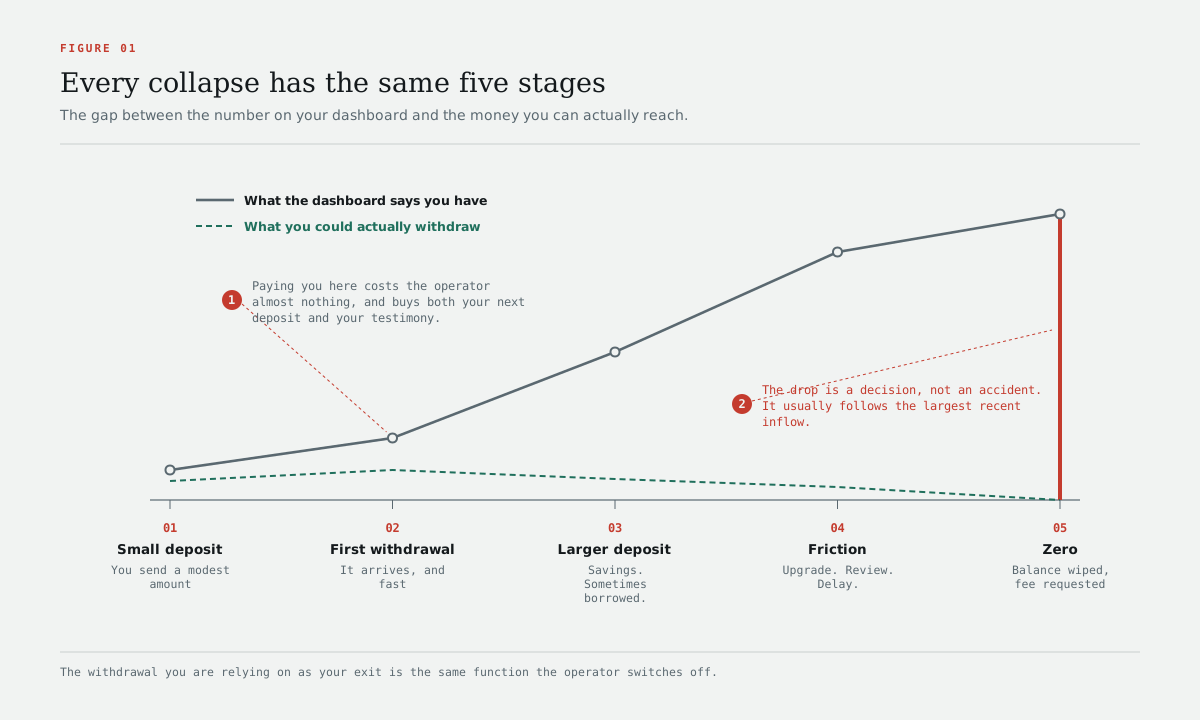
What goes wrong has a small number of variants. A tax must be paid before release. An anti-money-laundering check requires a deposit to verify your account. Your funds are in an active position and cannot be closed without topping up margin. Your account has been upgraded to a tier with a minimum balance. A regulator has frozen the withdrawal and a compliance fee will unfreeze it.
Every one of these is the same move
Pay us more to get your money. No legitimate financial institution has ever required a payment from you in order to release money it is holding for you. Fees come out of the balance. That is what a balance is for.
If you are reading this while somebody is explaining why you must send a further amount before you can withdraw, stop. That is the sentence I most want you to have read.
A note on blockchain hashes
If a platform deals in crypto, ask for the transaction hash, not the screenshot. A hash can be pasted into a public block explorer, and the explorer will tell you the amount, the time, the sending wallet and the receiving wallet, independently of anything the platform says.
Do not stop at "the hash is real". Check what it says. A genuine hash can show a transfer that has nothing to do with your account, or an amount that does not match, or a wallet with no history. And if the answer to a request for a hash is a reason why hashes cannot be shared, you have learned something.
Recovery scams, which are worse
When people realise they have been defrauded, they search for help. What finds them is a second operation offering to recover the funds, sometimes posing as a law firm, sometimes as a blockchain forensics company, occasionally impersonating law enforcement. The FBI logged more than 10,500 recovery scam complaints in 2025, with about $1.4 billion in losses. Victim lists are traded, so the approach often arrives unprompted and already knows details about your case.
Nobody legitimate requires an up-front fee to recover stolen funds, and nobody legitimate contacts you first. Report to your bank, to your national fraud reporting service, to the regulator, and to the police. In the UK that is Report Fraud, which replaced Action Fraud in December 2025, alongside your bank's fraud team.
Part Thirteen: "Registered" is not a sentence
When someone says a firm is registered, the correct response is a single word.
"As what?"
Not sceptical. Not aggressive. Just: as what. Because there are a dozen different things that can be registered, they authorise wildly different activities, and the whole trick lives in the space between them.
| What was obtained | What it means | What it does not permit |
|---|---|---|
| Company registration | The name exists on a companies register. Cheap, fast, no vetting of the people behind it. | Holding client money, giving advice, running an investment scheme, anything financial at all |
| Business or trade licence | Permission from a local authority to trade | Any regulated financial activity |
| Money Services Business registration | A filing obligation for money transmitters, largely anti-money-laundering in purpose | Investment services, advice, brokerage, or safeguarding of investments |
| Crypto asset registration | In most jurisdictions, registration for anti-money-laundering supervision only | Any promise about investment returns. It is not a consumer protection regime |
| Broker or dealer authorisation | Permission to execute trades for clients, with capital requirements and conduct rules | Discretionary management or advice, unless separately permitted |
| Investment adviser registration | Permission to advise, with suitability and conduct duties | Holding your assets, unless separately permitted |
| Fund authorisation | The specific product has been approved and is supervised | Anything the fund documents do not cover |
| Bank licence | Deposit-taking, heavily supervised, capital requirements, deposit protection | Note that almost nobody claiming this actually has one |
| Exchange recognition | Permission to operate a market | It does not mean the exchange endorses anything traded on it |
The most common move is registering the cheap thing and describing it in language that sounds like the expensive thing. A certificate of incorporation is a genuine document. It is genuinely worthless as evidence of anything financial.
How to check, in about four minutes
Go to the regulator's own website. Type the address yourself. Never use a link the firm sent you, because cloned firm sites and fake register pages exist and are common.
- UK: the FCA Register and the FCA's Firm Checker, launched in January 2025 and used more than 1.9 million times in its first year.
- US: FINRA BrokerCheck and the SEC's adviser search.
- Kenya: the Capital Markets Authority's list of licensees.
- Nigeria: the SEC's register of capital market operators.
- South Africa: the FSCA's list of authorised financial services providers.
- Elsewhere: search the country's name plus "financial regulator register".
Then check five things match, not one. Firm name. Reference number. Website address. Registered office. Directors. The classic cloned-firm fraud copies a real authorised firm's name and number and changes only the contact details, which is why checking the number alone is not enough. If the register lists a phone number, ring that number rather than the one you were given.
Then check the warning lists. The FCA publishes a list of firms it believes are operating without permission, and most major regulators do the same. Absence from a warning list means nothing, since new entities appear faster than they can be listed. Presence on one ends the conversation.
Then read what the permissions actually say. The register entry states what the firm is allowed to do. "Registered for anti-money-laundering supervision" and "authorised to hold client money and advise on investments" are entirely different states of being.
Part Fourteen: The shapes this comes in
The names change every eighteen months. The shapes do not. Here are the ones currently doing the most damage.
The long-relationship scam. Known in the trade by an ugly name that translates as "pig butchering", because the target is fattened before slaughter. It begins with a wrong number, a dating app match, or a LinkedIn message from someone with an impeccable profile. There is no investment talk for weeks. There is friendship, or romance, or business rapport, built patiently. The investment appears late, mentioned casually, almost reluctantly. This is the most expensive category in the world by total losses and its victims skew educated and middle-aged.
The industrial scale of it is worth knowing about. Much of this work happens in compounds across Southeast Asia and increasingly elsewhere. Researchers at Myanmar Witness have identified more than 137 suspected scam-related sites across the region, and say around half show indicators of forced labour, trafficking or abuse. When Myanmar's army raided the KK Park compound in October 2025, more than 2,000 workers were released and 30 Starlink terminals were seized. Analysts tracking satellite imagery report that compounds tend to disperse and rebuild rather than close.
I mention this for one practical reason. The person messaging you may be a victim themselves, working to a script, under supervision, with a quota. It is not personal, it was never personal, and there is no reasoning with the person on the other end because the person on the other end is not the one making decisions.
The fake broker or fake exchange. A complete trading platform with charts, order books, account tiers and a support desk, none of which is connected to any market. Your trades are simulated. Your balance is a number in their database. Often the branding is close to a real regulated firm's, sometimes character-for-character, with only the domain changed.
The signal group. Free signals, posted publicly, some of which win. What you are not shown is the selection: post ten predictions in ten private groups, five will look brilliant, and only the winners get screenshotted. Free signals convert to paid VIP tiers, which convert to "just deposit through my broker link", which is where the money actually is.
Copy trading with the losses removed. Real copy trading exists at regulated brokers, and it does copy the losses, which is why the returns are ordinary. The fraudulent version shows you a master account with an implausibly smooth equity curve you cannot independently verify.
The AI trading bot. Currently the strongest wrapper because it is unfalsifiable to a non-technical audience and it explains away the impossible consistency. Ask the same questions you would ask a human manager: strategy, capacity, drawdown, audit, custody. A real quantitative fund can answer those. A bot narrative usually cannot, because there is no bot.
The church, association or diaspora scheme. Introduced by someone respected, spread through a community, protected by the social cost of questioning it. These often run longest, because the reputational damage of asking hard questions falls on the asker.
The fake stock exchange or fake IPO. You are offered pre-IPO shares in a well-known private company at a discount, or shares on an exchange you have not heard of. Verify the exchange exists and is recognised by a regulator, and verify that any securities offering is registered where registration is required.
The mining, arbitrage or liquidity pool product. Deposit crypto, earn a fixed daily percentage. Real yield in crypto exists and is volatile and carries obvious mechanisms of loss. Fixed daily returns with no downside are the tell, in exactly the same way they are the tell everywhere else.
Exclusive mentorship and secret strategies. The product being sold is education, priced at £2,000, teaching a method that would stop working if it were taught widely. Ask why the strategy is being sold rather than used.
Part Fifteen: The numbers, if you want to chart them
Two small datasets, if you are building something visual or want to show this to somebody who trusts figures more than arguments.
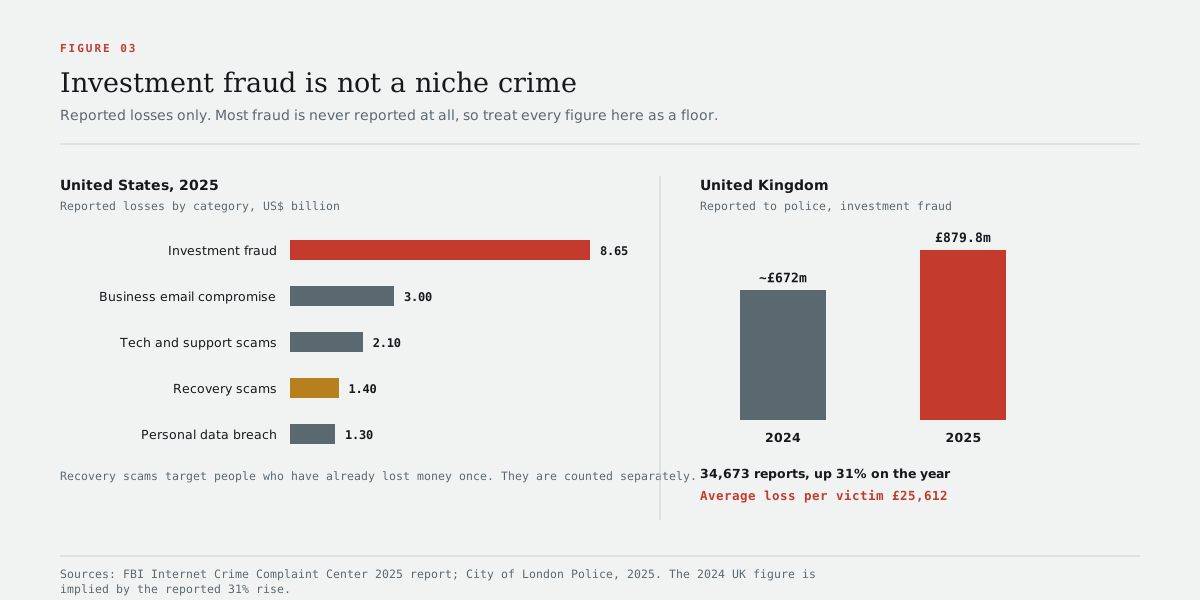
Reported US losses by fraud category, 2025 (FBI Internet Crime Complaint Center)
| Category | Reported losses (USD bn) |
|---|---|
| Investment fraud | 8.65 |
| Business email compromise | 3.00 |
| Tech and customer support | 2.10 |
| Personal data breach | 1.30 |
| Recovery scams | 1.40 |
Investment fraud is roughly triple the next category. It is also the category most likely to take everything, rather than a card's worth.
UK investment fraud, reported to police
| Measure | 2024 | 2025 |
|---|---|---|
| Reports | approx 26,500 | 34,673 |
| Total losses | approx £672m | £879.8m |
| Average loss per victim | £25,612 |
The 2024 figures are implied by the reported 31% rise, so treat them as approximate. Separately, UK Finance recorded around £221.5 million lost through investment scams reported by banks across roughly 15,000 cases, which is a much smaller number because it counts only losses that moved through UK bank payment channels. When two credible sources disagree by a factor of four, they are usually measuring different things, and it is worth knowing which.
Two more figures worth holding, from the same 2025 FBI dataset. Average reported loss across all fraud: about $20,700. Average where cryptocurrency was involved: about $62,600. And people over 60 accounted for roughly $7.7 billion of US reported losses, up 37% in a year.
Part Sixteen: The checklist
One page. Print it, screenshot it, whatever works.
Before any money moves
- I can explain, in one sentence, where the return comes from
- The business still works if nobody new joins
- I found the firm on a regulator's own website, which I typed in myself
- The reference number, name, address and website on the register all match
- The permissions cover what this firm is actually doing with my money
- The firm is not on any warning list I can find
- I know which institution holds client money, by name
- I know who audits them and where the accounts are filed
- I know what happens to my money if the firm fails
- I know whether any compensation scheme applies, and for how much
- Fees and lock-ups are in writing, from the firm, before I deposit
- I have searched the company name with "scam", "review" and "complaint", past page one
- I have checked the domain's registration date. A three-month-old domain with a ten-year track record is a contradiction
- The named experts exist outside this platform's own materials
- Nobody has told me this must be done this week
- My income does not increase when someone else deposits
- I have told one person outside the group and heard their reaction
- I can afford to lose all of it
Immediate stop signs
- I have been asked to pay a fee in order to withdraw
- I have been asked to keep it confidential
- I have been asked to send crypto to a personal wallet or to a named individual's bank account
- The returns have been fixed, daily or guaranteed
- The person's story changed when I asked a direct question
- I was moved off the platform where we met and into a private chat quickly
- Someone I have never met in person is managing my money
Any single item in the second list is enough to stop. You do not need a full house.
The 72-hour rule
Whatever it is, wait three days before sending money, every time, without exception. Real opportunities survive three days. This one rule would prevent a large share of the losses in this article, because urgency is not a feature of the opportunity, it is a feature of the pitch.
Part Seventeen: A worked example
Here is an invented platform. Any resemblance to a real one is because they are all built from the same parts.
Meridian Quant Capital. Your cousin sends you an invite link. The site is clean, dark blue, with a live ticker and a section on "institutional-grade algorithmic execution". There is a certificate of incorporation as a PDF, company number and all. There is a Telegram group with 4,200 members. Professor Adrian Kohl posts a market briefing each morning at 07:30 and it is, as far as you can tell, accurate. Members post withdrawal screenshots. Returns are advertised at 1.8% daily on the Silver tier. Your cousin has withdrawn twice. There are 40 places left in this round and registration closes Sunday.
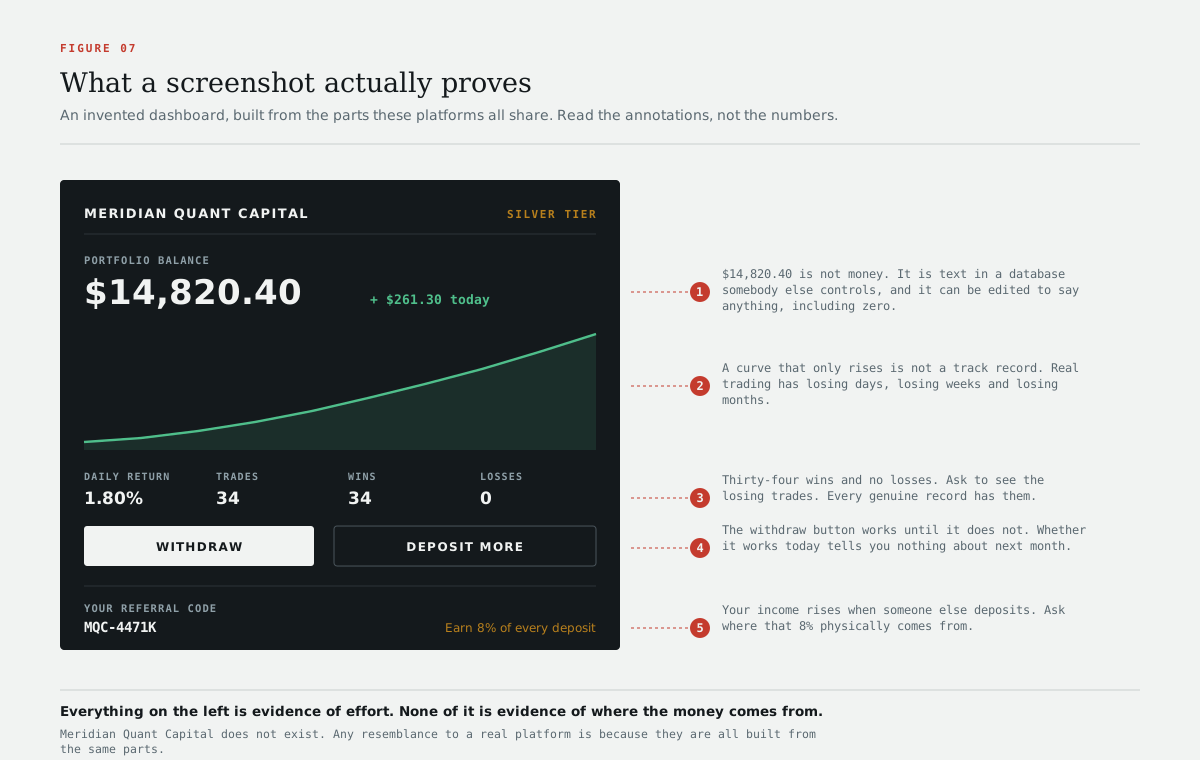
Here is how the investigation goes, in order, with roughly how long each step takes.
Step one, three minutes. Where does the money come from? The site says algorithmic execution across crypto exchanges. 1.8% daily compounds to more than 700% a year. If that were achievable, the strategy's own profits would fund it within months and it would not be open to the public at any price. The claim is not merely optimistic. It is self-refuting, because a strategy that good does not need external capital.
Step two, four minutes. Regulation. The certificate of incorporation says a company exists in a particular jurisdiction. It does not say the company may accept investment money. I go to the regulator's website in that jurisdiction, typing the address myself, and search the name. Nothing. I search the FCA Register. Nothing. I search the FCA warning list. Depending on the week, either nothing, or the whole thing ends here.
Step three, two minutes. The domain. A free lookup tool shows when the website was registered. Registered eleven weeks ago, with the registrant details hidden. The site claims operations since 2019.
Step four, five minutes. The professor. I search his name in quotation marks. Results appear only on the platform's own materials, its Telegram group, and two other trading sites. The university he claims does not list him. His photograph, run through a reverse image search, appears on a stock photo site.
Step five, two minutes. Custody. I ask in the group which bank holds client funds and who the custodian is. I am told funds are secured in cold storage with bank-grade encryption, which is a sentence about technology answering a question about ownership. I ask again, more specifically. I am told to speak to my account manager.
Step six, one minute. The referral structure. 8% of the first deposit of anyone I introduce, plus 3% of the second tier. So my income rises when my cousin's colleague deposits. Combined with 1.8% daily, the outflow commitments on every pound received exceed anything a real strategy produces.
Step seven, thirty seconds. The urgency. Forty places, closing Sunday. A fund that can compound at 700% a year has no interest in my £2,000 and no reason to impose a deadline. Scarcity here is not a feature of the product, it is a feature of the sales process, and noticing that distinction is most of the skill.
Total time: about eighteen minutes. No specialist knowledge required. The hardest part was not technical. It was being willing to ask my cousin a question that implied he might be wrong.
What I do about my cousin. This bit matters and most articles skip it. He is not lying to me, he has been paid twice and he believes it. If I tell him it is a scam he will defend it, because he has told other people about it and because his withdrawals feel like evidence. So instead I ask him to do one thing: withdraw the entire balance, all of it, today, and see what happens. That is a request he can act on without having to admit anything, and the platform's response answers the question better than I can.
Part Eighteen: What the real thing looks like, and why it is so dull
Having spent this long on fraud, it is worth stating clearly what ordinary, unglamorous, effective investing looks like, because a lot of people only ever encounter the fake version and assume the real one must be similar.
Index funds and ETFs. A fund that owns a slice of hundreds or thousands of companies at once and charges a very small annual fee, often under 0.2%. You are buying the average outcome of a large chunk of the world economy. Nobody is trying to beat anything.
Individual shares, if you want them, bought through a regulated broker, held by a custodian, transferable to another broker if you get bored.
Government bonds for stability and corporate bonds for a little more yield and a little more risk.
Your pension, which for most people is the single most valuable investment they will ever hold and receives the least attention. Employer contributions and tax relief produce returns no trading scheme can match, and they are real.
Property, which is genuinely a business with tenants and repairs, and which people persistently underestimate the work of.
Now the returns. A globally diversified portfolio has historically produced somewhere in the region of 7% to 10% a year over long periods, before inflation, with individual years ranging from roughly +30% to -35%. Over thirty years £300 a month at 7% becomes about £340,000, of which £108,000 is what you put in. That is the whole magic trick, and it takes thirty years, and there is no version of it that takes eight months.
Diversification is the only thing in finance that reliably gives you something without charging you for it. Owning one company means one bad announcement can halve you. Owning three thousand means no single company can do much of anything to you.
Legitimate investing feels like nothing is happening, most of the time. There is no group chat. Nobody congratulates you. The value goes down for a while and you are supposed to do nothing about it, which is genuinely hard, and which is roughly the entire skill.
If a proposition is thrilling, that is information. Thrill is not a feature of asset ownership. It is a feature of gambling, and of selling.
Frequently Asked Questions
I already sent money and now the withdrawal button doesn't work. What should I do?
Do not pay a further fee, tax, or "compliance charge" to release it — no legitimate financial institution ever requires a payment from you to hand back money it holds for you. Report it immediately to your bank's fraud team, your national fraud reporting service, and the police. Be wary of anyone who contacts you afterwards offering to recover the funds for an up-front fee — that is almost always a second scam.
Is it safe to keep investing if I've already been paid out once?
No. Being paid early is the product, not proof the platform is genuine — it costs the operator very little and buys your trust, your next (much larger) deposit, and your testimony to everyone you know. You also have no way to know where you are in the deposit-versus-withdrawal curve; the operator can see it, and you can't.
What is the one question I should always ask before investing?
If nobody new joined tomorrow, would this business still make money? A real investment — shares, property, a business — keeps producing income regardless of new investors. If the honest answer is that today's payouts depend on tomorrow's deposits, you're looking at a structure that must eventually collapse.
How do I actually check whether a firm is regulated?
Go to your country's financial regulator's website by typing the address yourself, never through a link the firm sent you, and search the firm's name. Then check that the reference number, registered address, directors and website all match what you were shown — cloned-firm scams copy a real firm's name and number and change only the contact details. Finally, check the regulator's warning list, and confirm the firm's permissions actually cover what it's doing with your money, not just that it's "registered" for something narrower.
Part Nineteen: The last thing
I have written a lot of questions here and I want to end with the reason they work, which has less to do with the answers than you would think.
Ask a properly regulated firm which regulator authorises them and you get a number, immediately, usually in the email footer already. Ask who holds client money and you get the name of a bank. Ask what happens if they fail and you get a link to a compensation scheme. None of this is a favour. Firms answer because they are required to and because they have nothing riding on your ignorance.
Ask the same questions of an operation that depends on your not asking, and the temperature changes. You will be told the information is proprietary. You will be told that successful people do not overthink. You will be told, sometimes gently and sometimes not, that you are being negative, that others are already making money, that this is exactly why some people never get ahead. You may find that the person who introduced you gets hurt.
That reaction is the most reliable signal in this entire article, and it costs nothing to obtain. You do not need to catch anyone out. You just need to ask a plain question and pay attention to whether it is answered or managed.
Two things to leave with.
The first is that your savings only have to disappear once, and if you borrowed to invest them, once is not even the limit. That is the difference between a bad investment and this. A bad investment puts you back where you started. A scheme funded with a salary loan or a cooperative advance puts you years behind it, repaying a debt for money that stopped existing months ago. Opportunities are not scarce. There will be another one next month and another one after that, and none of them will be the last one, whatever the countdown timer says. The asymmetry between waiting three days and losing everything is so enormous that hesitation is almost always the correct trade.
The second is for whoever is reading this too late, which given the numbers is some of you. It was not stupidity, and it was not greed either, whatever the comment sections say. The operation was built by people who do this professionally, at scale, with scripts refined across thousands of attempts, and 78% of the people the FBI warned in 2025 had no idea until they were told. Report it, to your bank first and fast, because there are cases where funds are still recoverable in the first hours. Tell someone. Do not pay anyone who promises to get it back.
And the answer to the fee, always and in every case, is no.
This article explains general principles and common warning signs. It is not financial or legal advice, and it does not allege wrongdoing by any specific business. Whether a particular scheme is unlawful is a matter for regulators and courts. Check any firm with the financial regulator in your own country before you send money.
Sources